
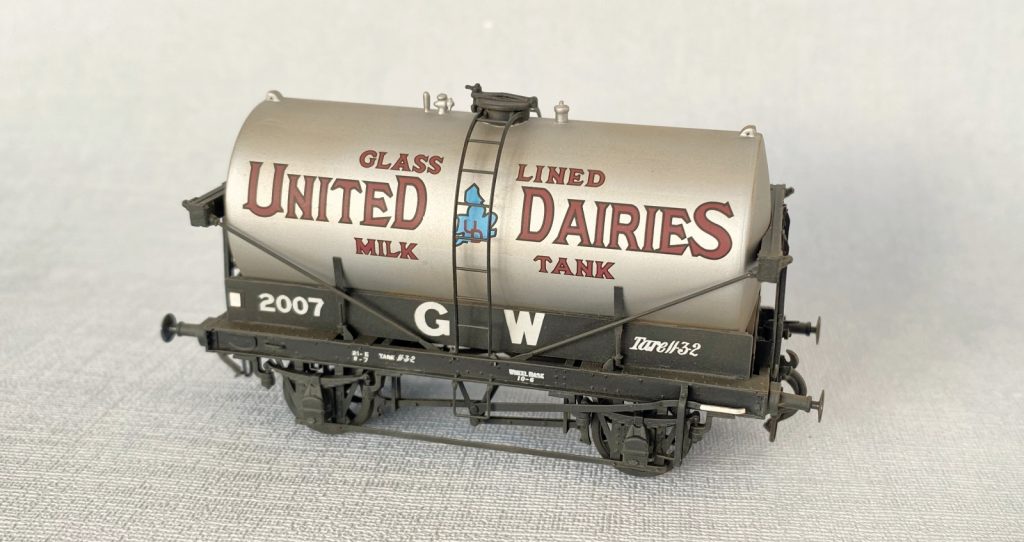
This is a reworking of an article that appeared in MRJ 315.
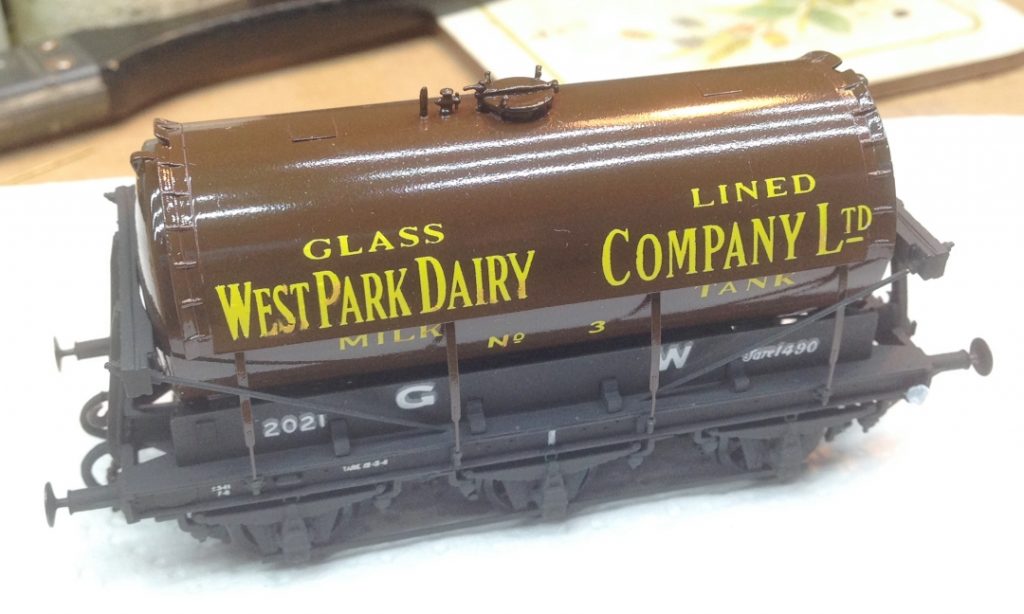
Way back in 2018, I built a model in P4 of a GWR O.35 milk tank on behalf of a customer using my etches and the David Geen kit. The model was finished by Gerry Beale in West Park Dairy livery and was intended for use in an early 1930s GWR parcels train. Once the model had been completed and delivered discussions turned to something that could go with it. The West Park Dairy livery was GWR brown above the solebar so would perfectly match the parcels train but ideally a companion would provide a bit of colour. At this point in time the construction of 6 wheeled milk tanks was only just getting going and most were still 4 wheeled. The O.23 tanks would best fit the bill as they were owned by United Diaries and weren’t brown but there was no suitable kit available. There was at least UD transfers available for the tank from the trade, and I had some spare tank fittings from my David Geen kits. I suggested that I could create a kit to solve the problem and then I could build it to arrive at the kind of model that was being sought. There ended up being a bit of a protracted timeline to this project as Covid pandemic related lockdowns got in the way but etches were obtained, backlogs cleared and work finally begun.
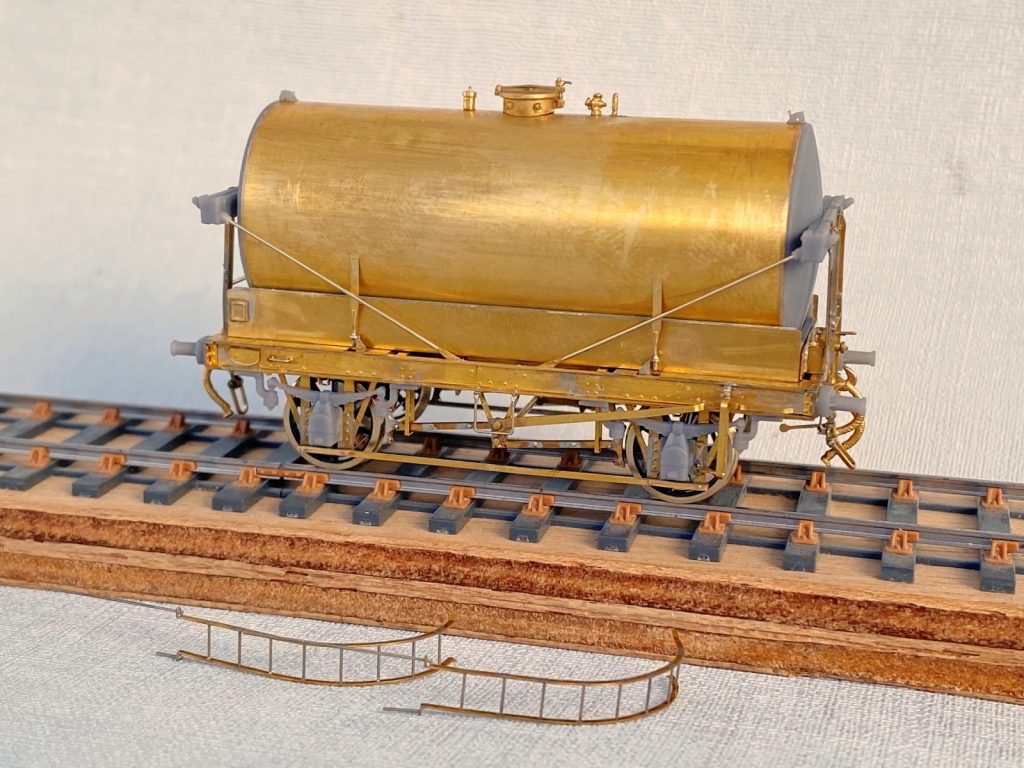
At the time of suggesting I could create a kit for an O.23 milk tank I had been working a lot on oil tanks and there were a lot of similarities to drawn on. I drew up etches for an open underframe of the right length and wheelbase, brakegear, tank and formers, end stanchions and ladders. The list of 3D printed detailing parts grew as even things like accurate buffers weren’t available from the trade. Artwork had to be done for the springs and axleboxes, cradle and crossheads as well as the buffers which were a round 2 rib type with a wooden packing piece on the earliest O.23 builds, which the model intended to depict. The tank ends were also 3D printed to save me raiding my stocks of David Geen parts, though I did use cast brass steam and vacuum pipes from that source. Ultrascale wheels and Rumney Models screw couplings completed the build.
I arranged, as I try to do if I can, for the tank to be painted separately from the rest of the wagon. I have tried painting tank wagons where the tank is a different colour and everything is assembled and it’s a nightmare. Much less stressful to put a little extra work into arrange things to make this part of the process easier. The underframe was nice and straightforward as it was black on the prototype, but the tank had me scratching my head for a bit. Some references suggested a white tank and the SR United Diaries tanks certainly were, but this was at odds with the images I was working from. The tanks on these GWR four wheeled wagons had a distinct metallic tone and were definitely not the same colour as the underframe lettering which we know was white. In the end I chose to go for an unpainted aluminium clad tank which is how I believe they were finished and how a lot of milk tanks ended up being finished. I used Alclad 2 for this which I had heard good things about and was very impressed with. I have also used their high speed silver on oil tanks and would recommend them. They are cellulose based so precautions need to be taken when spraying but they give a lovely finish. Alclad disappeared but the paint lives on and it is now marketed by Ammo (by Mig Jimenez) in their A-Stand range.
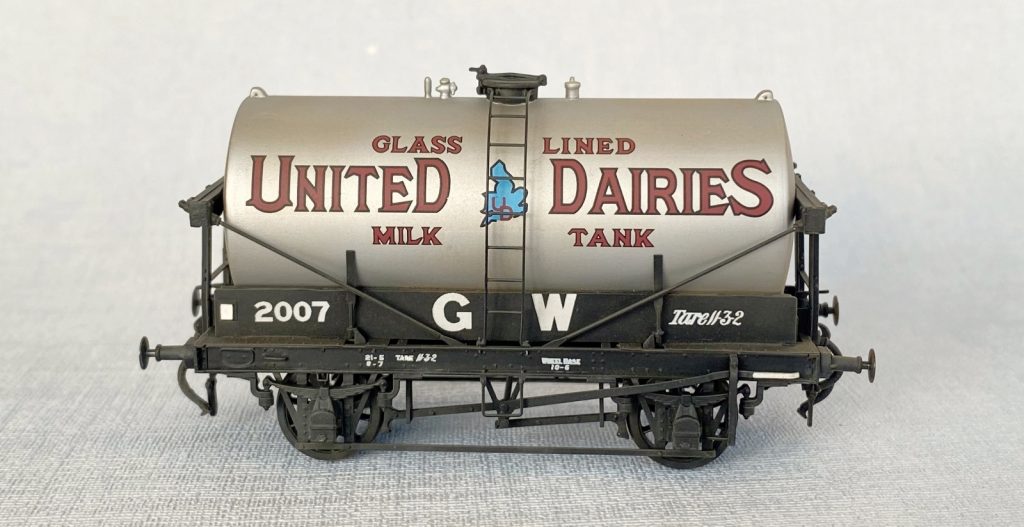
The aforementioned United Diaries transfers for the tank are from Fox Transfers but as they are intended for LMS milk tanks all the underframe letting is wrong. Again, searches of the trade proved unsatisfactory, so I drew up the necessary artwork in AutoCAD and it was printed in white for me by the very helpful John Peck at Precision Decals. A little light weathering completes the model.
Creating this model ended up being quite an undertaking, with having to create the ‘kit’ and underframe transfers as well as building it but it is exactly the kind of pathfinding modelling that I love doing. I find it immensely satisfying to produce something where not only do I get the sheer joy that comes from having created something myself but have also end up with a model that’s a bit different and I think that’s important. With the current rush towards all things RTR there is a danger that everything starts to look the same. They are never going to be able to cover everything despite what some of them might lead you to believe. 3D printing offers answers of course but not all of them and much is of dubious quality, either in terms of research, design or finish. Railways in this country have been blessed with wonderous variety whether that be locos and stock, architecture, signals or rail chairs; the list goes on and that’s before you look outside the railway boundary. If you want to vaguely accurately represent all, or even some of that you need to sometimes go beyond using what is available to you that somebody else has done and make something yourself.
Justin Newitt – March 2026