
As far as steam era wagons are concerned, I don’t think there was anything more complicated than those vacuum braked hoppers where the hopper design precluded the use of a brake cross shaft where you might ordinarily expect to find one. This simple design restriction led to some pretty exotic brakegear arrangements, especially when allied to the fact that the only place to put a vacuum cylinder on a lot of these wagons was at the ends and on top of the underframe. Hoppers themselves from this period could be quite complicated, full of plate and stanchions with a big hole in the underframe but add to this some convoluted fitted brakegear, often with two cylinders and changeover gear, and a vacuum pipe for which there was little space and you have the recipe for something that takes some modelling. This family of ‘complicated’ wagons included hoppers for iron ore and grain, the 12’ wheelbase Prestwins (the most complicated of all), and the Presflos, immortalised in model form by Airfix back in the 1960s.
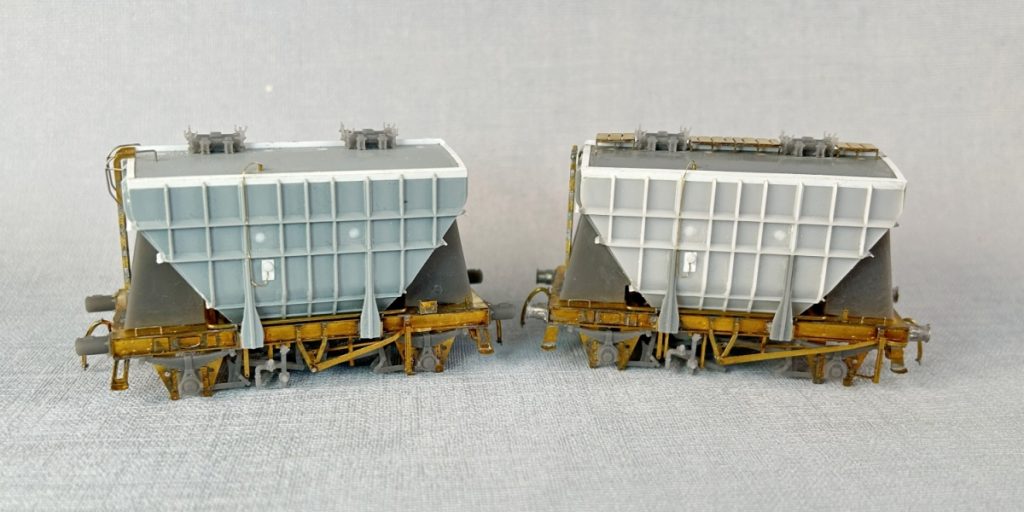
I first thought about doing an underframe and detailing for the ‘standard’ 10’ 6” wheelbase Presflo wagon many years ago. I measured up and photographed a Tunnel Cement Presflo at Quainton back in 2013 but was put off by the brakegear which is descended from the arrangement used by the NER on their hoppers and would be a nightmare to etch. 3D printing has since offered an answer to that problem and a commission led to the artwork for the etched bits. Sadly the ‘commission’ proved to be a dead and expensive end but a conversation with Richard Oldfield of Mostyn fame led to its resurrection, and it is thanks to him that the project was finished. Otherwise, it might have stayed indefinitely in the failed commissions draw. It might also have stayed there if I had realised beforehand just how much work was going to be involved in producing parts to cover all the basic variations. In this ‘article’ I will attempt to cover all those basic prototype variations. Modelling the wagons will be covered separately.
Prototype Notes
The Presflo was British Railways specialist answer to conveying bulk powders, principally cement. The design used compressed air to assist with the discharge of the load and can only be described as a success with examples lasting well into the 1980s. The prototype appeared in 1954 and building of the standard 10’6” wheelbase Presflos to diagram 1/272 continued for the next 10 years. There was also a 12’6” wheelbase version for fly ash but we will not touch on those here.
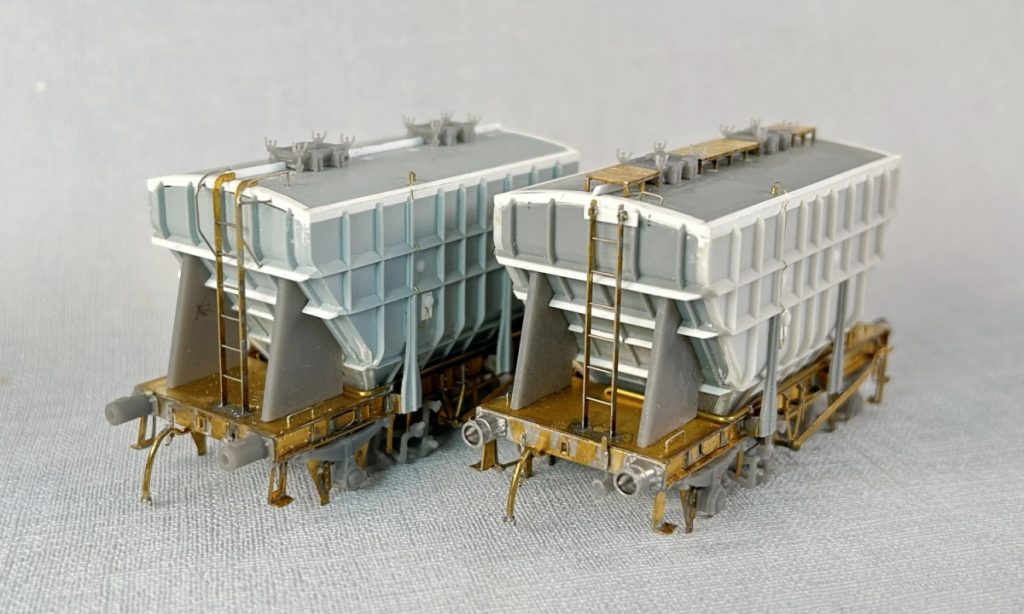
Over the course of construction there were several variations within the basic design. The most obvious of these was two types of brakegear each with different length brake levers, two types of ladders and two styles of steps. On top of this there were two styles of pressure gauge piping, and the arrangement of hopper bottom and discharge piping were different depending on whether the Presflo was BR or privately owned. There was also a range of valve wheels for the discharge pipes. The prototype was a bit different to the production versions in several respects, but one notable feature was the lack of side stanchions. It has been suggested to me that early Shildon builds didn’t have them either, at least to begin with. I would love to see a picture though.
Starting from the beginning of the production version, early builds (lots 2769, 2863 & 3029) had a single vacuum cylinder and brakegear with simple push rod brakes acting on a crank on the brake lever shafts. They were fitted with long brake levers with the lever guard on the outside of the right hand axleguard. The first two lots had an early style ladder which was mounted at the top to a plate welded onto two of the stanchions. There was a small grab handle fitted to the top of the hopper by the ladder and they plate style steps. Lot 3029 had a different style ladder which curved up at the top to be fixed on the top of the hopper along with more involved handles that came part way down the ends from the hopper top. They also had steps fabricated from angle. Both these features were continued throughout the rest of the production.
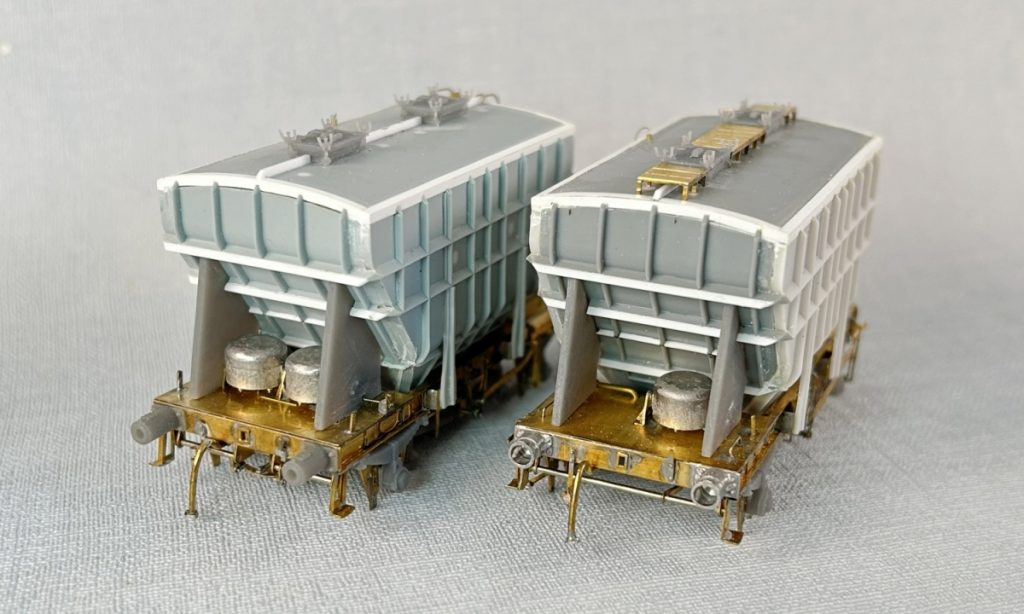
Everything else had twin vacuum cylinders with changeover levers and had brakegear with compensated links around the brake lever shafts. They were fitted with short brake levers with the lever guard on the inside of the right hand axleguard.
Buffers were 1’6” self-contained on the first two lots with Instanter couplings. The next few lots of BR built wagons had a right mixture with 1’8½“ self-contained buffers (either GWR style or BR), 1’8½“ or 2’ Oleo and 1’8½“ or 2’ Dowty featuring. Wagons fitted with 1’8½“ buffers had standard screw couplings while those with 2’ buffers had UIC type screw couplings with two shackle type links from the drawbar hook rather than a U shaped bar link. This settled down in about 1960 with everything from that point onwards having 1’8½“ Oleos and Instanter couplings.
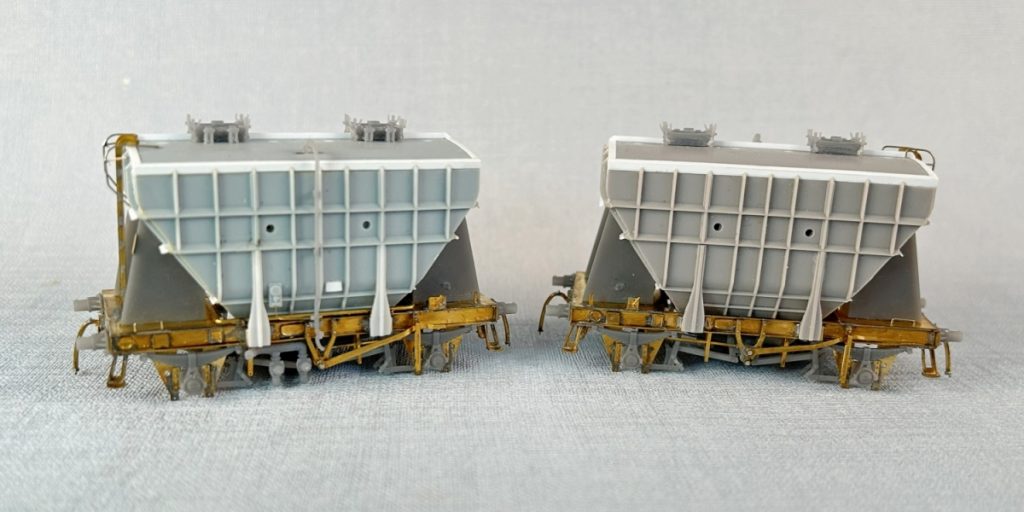
The first three lots had oil axleboxes when built. These were replaced with roller bearings in the 1960s. The rest had roller bearing axleboxes from new. There were at least 5 types of roller bearing and everything had 9 leaf springs.
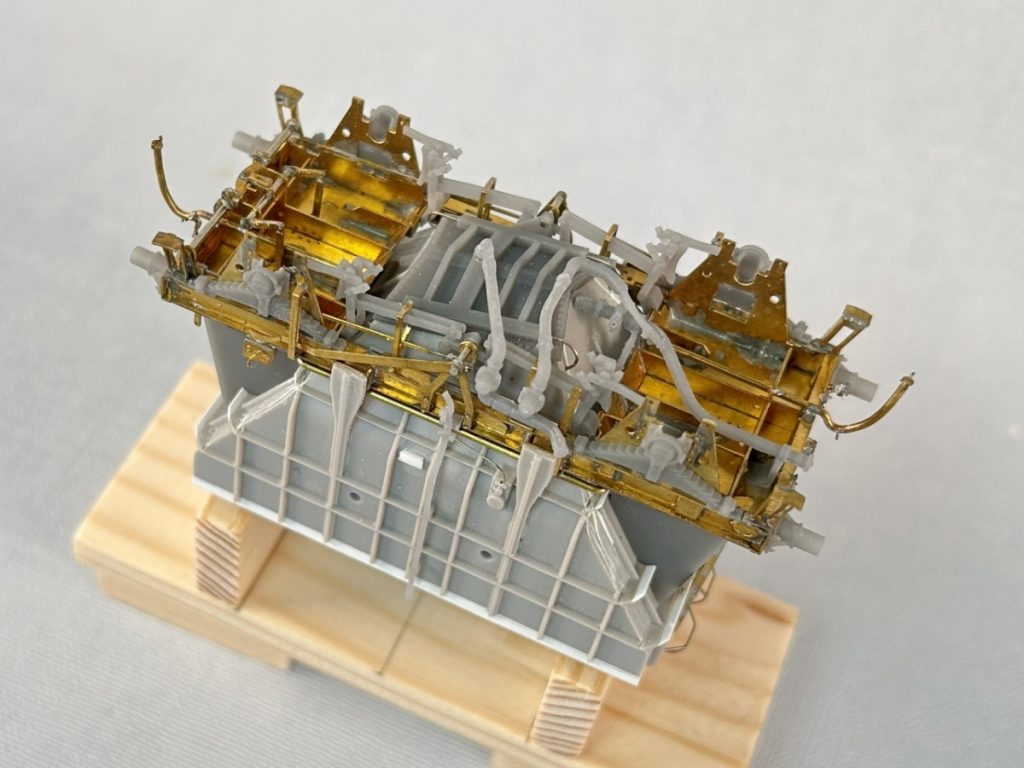
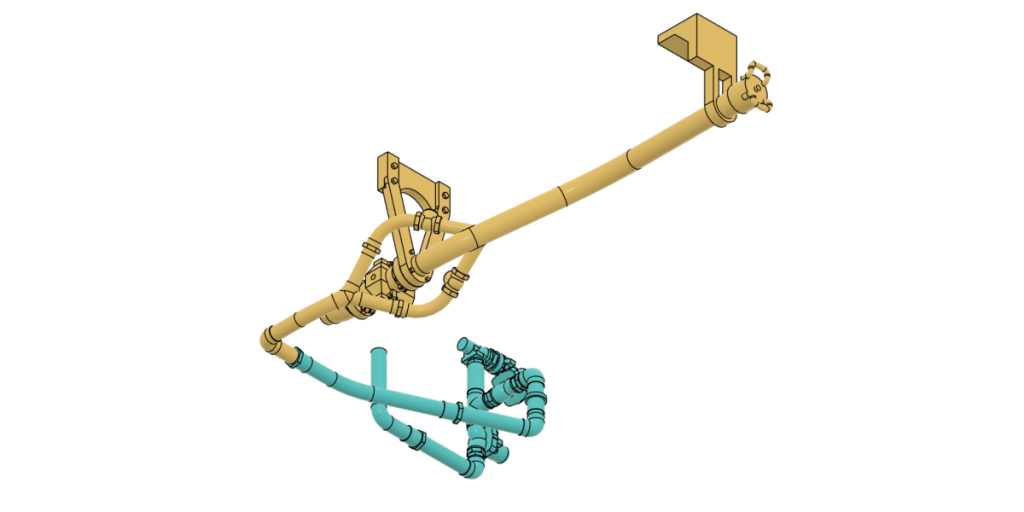
The main discharge pipe from the bottom of the hopper seemed to be the same on all but the arrangement of air pipes was different depending on whether the Presflo was BR or privately owned. The PO air pipes were bigger and fed into the hopper bottom in a different place. The hopper bottoms themselves also had a different arrangement for BR and PO builds. There was a pressure gauge on the pipe side of the hopper. On early BR builds there was a simple small pipe which ran up the side of a stanchion from the gauge into the top of the hopper. At some point, probably starting in 1960, this arrangement was changed. Now there was an additional larger pipe leading down from the top of the hopper and the pipe to the pressure gauge linked into that. The pressure gauge was also in a different position on BR and PO builds. Early builds were modified to the latter arrangement in the 1960s.
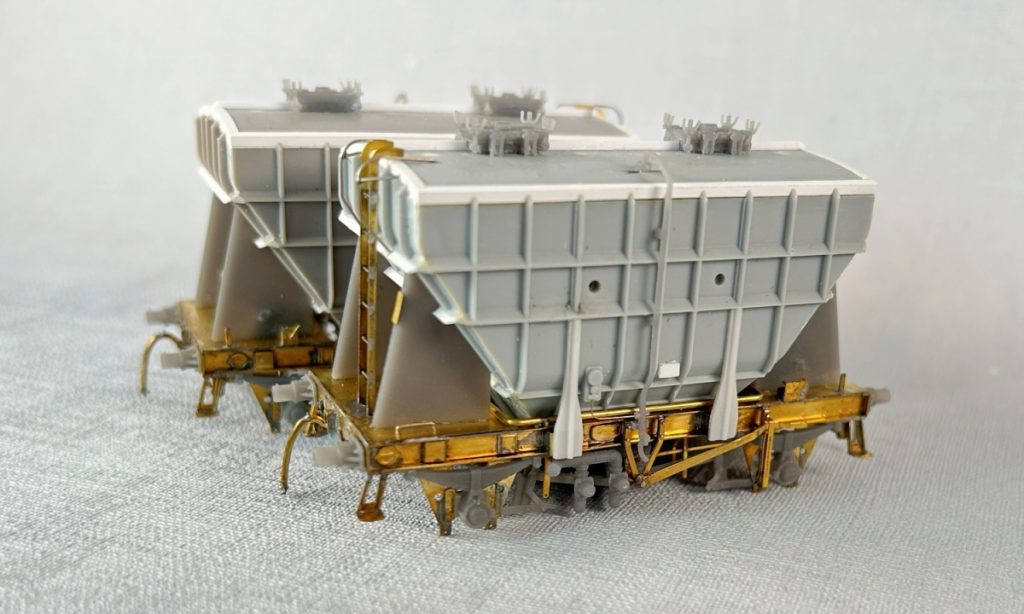
There were also other small detail differences. The Shildon and Met Cam builds had grab handles on top of the underframe in all four corners, everything else seemed to have them at the ladder end only. The Met Cam built wagons also had grab handles half way up the end stanchions at the ladder end. Instruction boards appeared in the mid 1960s on the pipe side, mounted to the top of the underframe between the side stanchions.
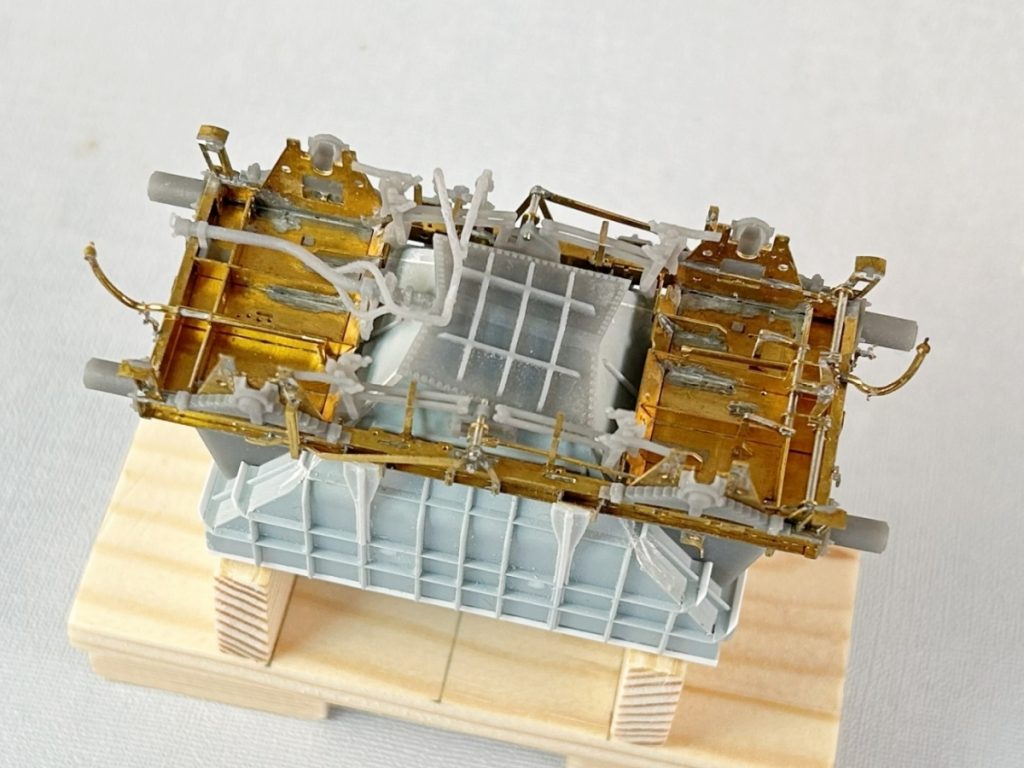
10 wagons were converted from lot 3177 for ferry use for a specific Fuller’s Earth flow. They had continental style buffers, 2’ UIC couplings, tie down rings and continental style label boards. The traffic for which they were intended ceased in the early 1970s after which they went into general use, though they retained their distinctive ferry fittings.
Finally, I think, 20 of lot 3029 were built for ICI salt traffic and had two silos within the same body. Due to the two silos, they had a different hopper bottom and two set so of discharge pipes. They were painted ICI blue. In the 1960s they were transferred to other traffics including Delafilla and slate powder.
Prototype Details
BR Diagram 1/272
Early brakegear with single vacuum cylinder, long brake levers, early style ladder and small grab handle on hopper top, plate steps, grab handles on all four corners, 1’6” self-contained buffers (mainly BR but occasionally GWR style 2 rib), Instanter couplings, oil axleboxes when new:
- B888801-B888110 2769 Shildon 55
- B888111-B888180 2863 Shildon 56
Early brakegear with single vacuum cylinder, long brake levers, late style curved top ladder and grab handles, fabricated steps, grab handles on all four corners and ladder end stanchions, 1’8½“ self-contained buffers (GWR style 2 rib with backing plate), screw couplings, oil axleboxes when new. 20 from this lot were built for ICI salt traffic with twin silos, hopper bottoms and pipes.
- B888181-B888280 3029 Met Cam 57/8
Late brakegear with twin vacuum cylinders and changeover levers, short brake levers, late style ladder and grab handles, fabricated steps, grab handles on all four corners and ladder end stanchions, 1’8½“ self-contained (BR style), Oleo or Dowty and screw couplings, roller bearing axleboxes.
- B888281-B888580 3156 Met Cam 58/9
Late brakegear with twin vacuum cylinders and changeover levers, short brake levers, late style ladder and grab handles, fabricated steps, grab handles on top of underframe at ladder end only, roller bearing axleboxes.
1’8½“ self-contained (BR style), Oleo or Dowty and screw couplings. 2’ Oleo or Dowty buffers and UIC type screw couplings. 10 wagons from lot 3177 had Ferry fittings with 2’ continental style self-contained buffers and UIC type screw couplings.
- B888581-B888880 3175 Central 58/9
- B888881-B888980 3176 Butterley 58/9
- B887800-B887999 3177 Gloucester 58/9
1’8½“ Oleo buffers, Instanter couplings.
- B873024-B873197 3323 Gloucester 60
- B873200-B873369 3361 Gloucester 61
- B873420-B873569 3406 Gloucester 61/2
- B873570-B873719 3409 Central 61/3
- B873794-B873893 3497 Central 64
All BR built Presflo appeared in freight stock red with black underframes except the 20 built for ICI salt traffic which were in ICI blue. Many were branded for specific traffic or companies, including Fuller’s Earth, Rugby Cement, Tunnel cement and APCM with ‘Blue Circle’ roundel boards on the side of hoppers.
Wagons built with oil axleboxes were given roller bearings in the 1960s.
APCM
228 Wagons built in two lots by Butterley. The first lot was built 1960 and the other in 1963. Registration numbers 8601-8828.
Late brakegear with twin vacuum cylinders and changeover levers, short brake levers, late style ladder and grab handles, fabricated steps, 1’8½“ Oleo buffers, Instanter couplings, roller bearing axleboxes.
The first batch was initially painted yellow, the second grey with black underframes. All had rectangular boards mounted on the side of the hoppers with Blue Circle Products branding.
Tunnel Cement
8 wagons built by Butterley in 1960. Registration numbers 8951-8958.
Details as per the APCM wagons.
Livery was freight stock red with black underframe.
Tops Codes
CP001A – 1’6” Buffers – Lots 2769, 2863
CP001B – 1’8½“ Buffers – Lots 2769, 2863, 3029, 3156. 3175, 3176, 3177 (all part), Lots 3323, 3361, 3406, 3409, 3497
CP001C – 2’ Buffers – Lots 3156. 3175, 3176, 3177 (all part)
References
- Paul Bartlett’s website of wagon photos.
- BR Diagram Books, courtesy of the Barrowmore Model Railway Group.
- Wagons of the Middle British Railways Period by David Larkin
- Wagons of the Late British Railways Period by David Larkin
- British Railways Wagons by Don Rowland
Justin Newitt August 2026